
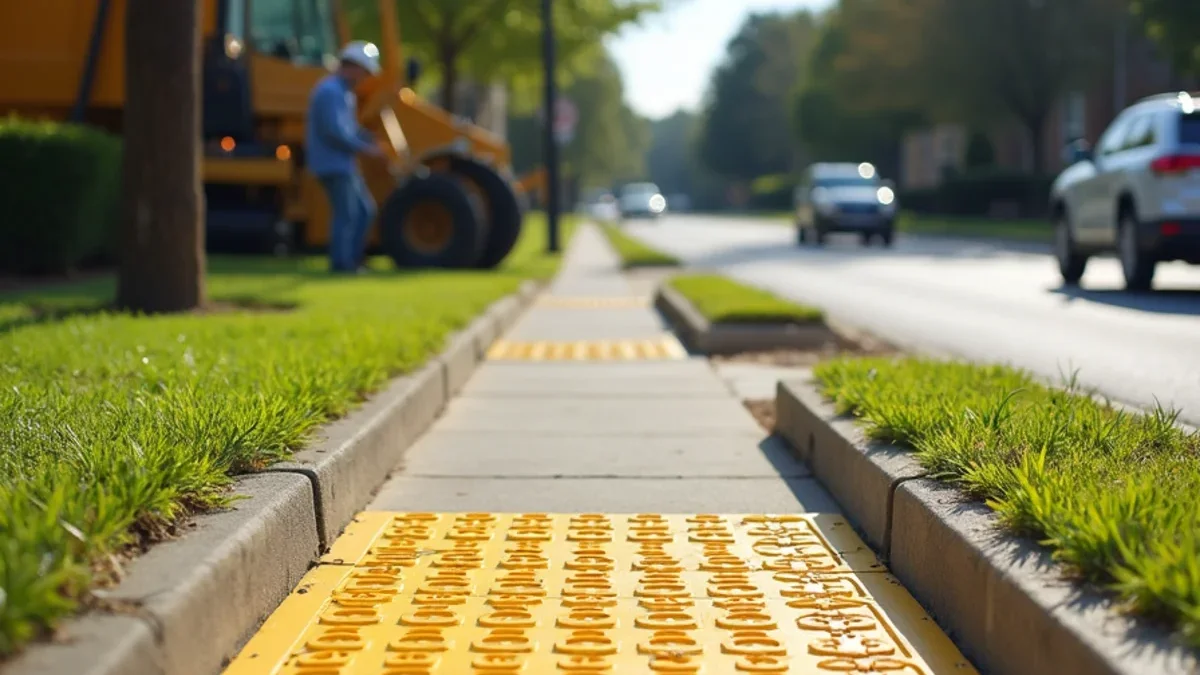
Commercial and HOA concrete sidewalks in South Carolina must comply with ADA Title III and local codes: minimum 36 to 60-inch clear width, maximum 1:50 (2%) cross slope, 1:20 (5%) running slope, and strict prohibition of vertical tripping offsets exceeding 1/4 inch. Non-compliant offsets between 1/4 and 1/2 inch must be beveled, while larger displacements require full panel replacement.
ADA Title III Legal Mandates for South Carolina Properties
For commercial property owners, shopping centers, municipal managers, and homeowners associations (HOAs) across Aiken County and North Augusta, sidewalk maintenance is not merely an aesthetic concern—it is a critical legal and financial responsibility. Under Title III of the Americans with Disabilities Act (ADA) and the South Carolina Accessibility Code, property owners are legally required to maintain an accessible, barrier-free route of travel for all pedestrian traffic.
Failure to maintain compliant walkways exposes property owners to severe premises liability lawsuits, personal injury claims from trip-and-fall incidents, and federal accessibility enforcement actions. A single pedestrian trip-and-fall on an uneven commercial sidewalk can result in tens of thousands of dollars in medical settlements and legal defense fees.
Investing in proactive accessibility maintenance—including specialized Sidewalk Trip Hazard & ADA Repair and precision Concrete Sidewalks & Walkways installation—ensures your community walkways remain 100% compliant and safe for all residents.
Critical Dimensions: Width, Cross Slope & Grade Tolerances
Federal ADA standards (Section 403) mandate strict geometric tolerances for pedestrian accessible routes:
Minimum Clear Sidewalk Width - Continuous Width: Sidewalks must maintain a continuous minimum clear width of 36 inches (915 mm). - Passing Spaces: If a sidewalk is less than 60 inches wide, passing spaces measuring at least 60x60 inches must be provided at intervals not to exceed 200 feet, allowing two wheelchair users to pass safely. - Municipal Standard: In North Augusta and Aiken, municipal commercial sidewalks are standardly poured at 60 inches (5 feet) wide to eliminate passing space requirements.
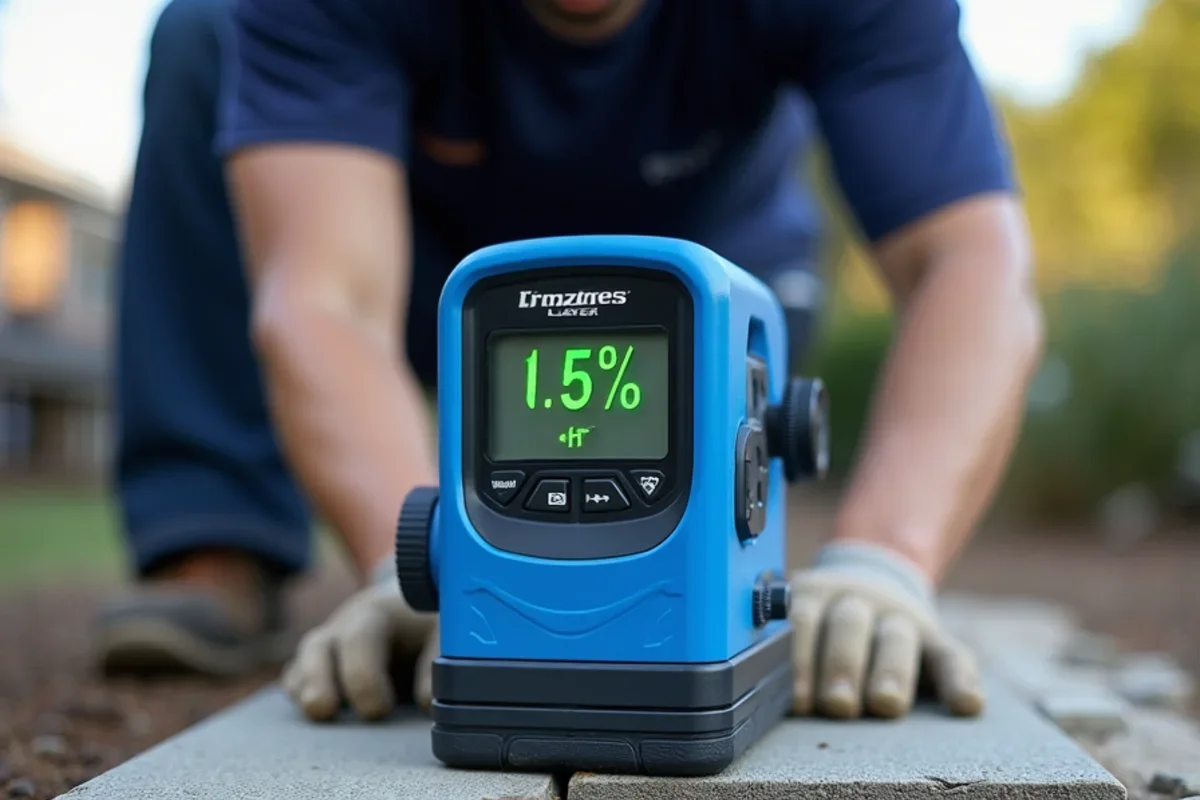
Running Slope and Cross Slope Limits - Maximum Running Slope: The slope parallel to pedestrian travel must not exceed 1:20 (5.0%). Any walkway exceeding a 5% slope is legally classified as a ramp and must incorporate handrails, level landings every 30 feet, and edge protection. - Maximum Cross Slope: The slope perpendicular to the direction of travel must never exceed 1:50 (2.0%). Cross slopes allow rainwater to shed off the concrete, but excessive cross slope causes wheelchairs and walkers to veer sideways off the path.
Trip Hazard Thresholds: The 1/4-Inch Liability Line
ADA Section 303 establishes unequivocal vertical clearance guidelines:
- Vertical Offsets Under 1/4 Inch (6.3 mm): Permitted. Surfaces are considered flush and require zero mechanical treatment.
- Vertical Offsets Between 1/4 Inch and 1/2 Inch (6.3 to 12.7 mm): Must be beveled with a slope not steeper than 1:2 (50%). Hand-chipped rough edges violate code; bevels must be smooth and uniform.
- Vertical Offsets Exceeding 1/2 Inch (12.7 mm): Prohibited. Must be treated as a ramp or eliminated via structural leveling, diamond shaving, or full panel replacement.
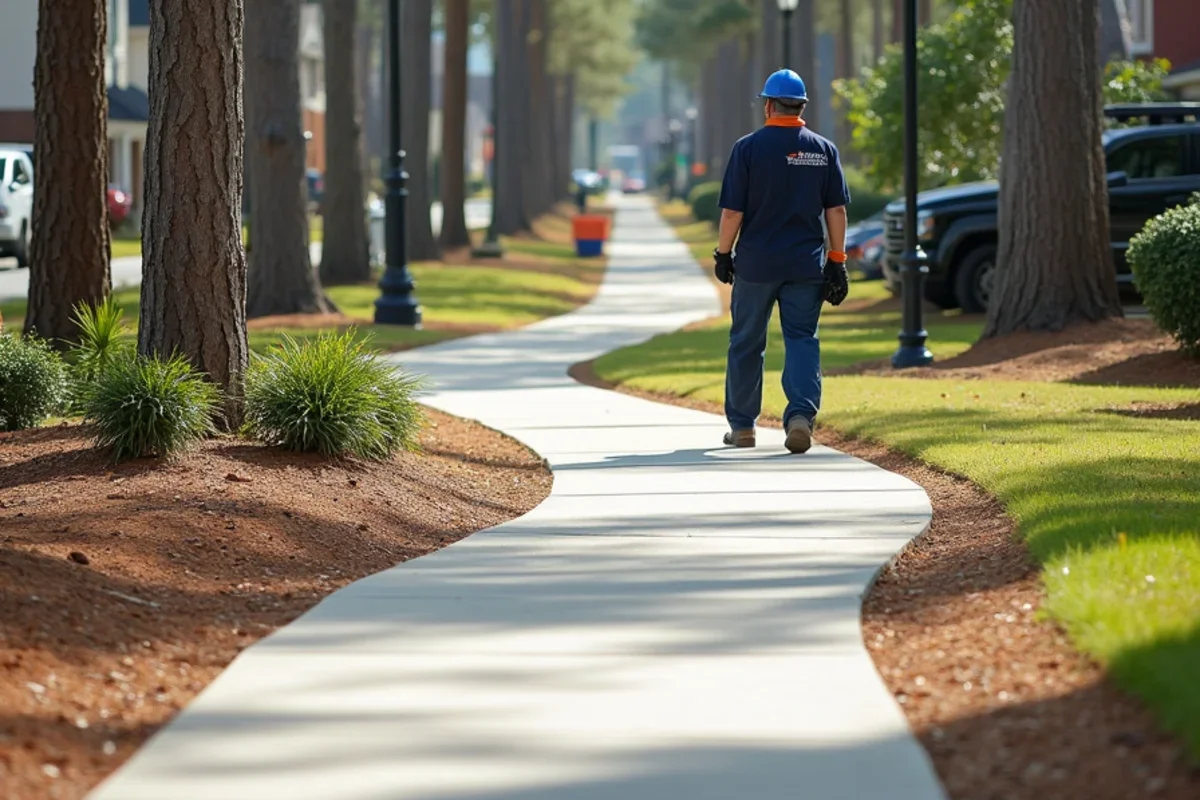
In South Carolina communities with mature pine and sweetgum trees, tree roots frequently lift sidewalk panels 1 to 3 inches into the air. Tree root upheaval creates immediate, actionable trip hazards that must be remediated promptly.

Curb Ramps and Detectable Warning Truncated Domes
Where sidewalks transition across curbs into vehicular parking areas or municipal streets, property owners must install compliant curb ramps:
- Maximum Ramp Slope: 1:12 (8.33%) running slope with 1:10 flared sides.
- Detectable Warning Surfaces (ADA Section 705): Curb ramps must incorporate truncated dome tactile warning pavers extending the full width of the ramp (minimum 24 inches in depth). These raised domes alert visually impaired pedestrians that they are entering a hazardous vehicular roadway.
- Color Contrast: South Carolina guidelines require truncated domes to contrast visually with surrounding concrete (standard safety yellow or dark brick red).
Remediation Techniques: Dustless Shaving vs Panel Repour
When sidewalk trip hazards are identified, facility managers have two proven engineering remedies:
Technique 1: Precision Dustless Diamond Shaving For offsets between 1/4 inch and 3/4 inch where the concrete is structurally sound and free of cracks, horizontal diamond shaving is the gold-standard repair. We utilize walk-behind diamond scarifiers equipped with HEPA dust extraction to shave the lifted concrete edge back at a gentle 1:8 or 1:12 ADA-compliant slope. Shaving costs 70% to 80% less than replacement, creates zero noise or sidewalk closure, and eliminates liability in minutes.
Technique 2: Surgical Saw-Cutting and Full Panel Replacement When a sidewalk panel has shattered into multiple pieces, tilted beyond 2% cross slope, or suffered subgrade erosion, shaving is no longer viable. We saw-cut clean joint lines, excavate the broken panel, remove invasive tree roots, compact a 4-inch crushed stone aggregate base, drill #4 rebar dowels into adjacent panels, and pour 4,000 PSI ready-mix with a non-slip broom texture.
ADA Sidewalk Compliance Checklist and Tolerances Table
| Parameter / Feature | ADA Federal Standard | SC Commercial Practice | Remedial Action if Non-Compliant |
|---|---|---|---|
| Vertical Surface Discontinuity | Max 1/4" flush; 1/2" if beveled | Strict 1/4" threshold | Dustless diamond shaving or panel replacement |
| Sidewalk Cross Slope | Maximum 2.0% (1:50) | Target 1.5% for drainage | Laser-guided subgrade leveling & repour |
| Sidewalk Running Slope | Maximum 5.0% (1:20) | Topographic match | Install ADA ramp with handrails & landings |
| Clear Path Width | Minimum 36 inches | 60 inches (5 feet) | Widen walking path or pour passing bays |
| Surface Slip Resistance | Firm, stable & slip-resistant | Medium broom finish | Acid etch, diamond scarify, or apply grip sealer |
| Expansion Joint Gaps | Max 1/2" opening | 1/4" to 3/8" tooled joints | Fill wide joints with elastomeric sealant |
Next Steps: Eliminate Sidewalk Liability on Your Property
Do not wait for a premises liability lawsuit or resident injury. Contact FPC Construction at (833) 334-0468 for a free comprehensive ADA sidewalk inspection, GPS trip hazard mapping, and written itemized quote within 24 hours.
Municipal Right-of-Way Compliance and Walkway Encroachment
When installing or repairing public sidewalks in North Augusta and Aiken, property owners must coordinate with municipal public works departments. Sidewalk transitions crossing street curbs require formal right-of-way encroachment permits and inspections. FPC Construction coordinates all municipal filings, ensures grade tolerances comply with local zoning setbacks, and installs approved cast-iron truncated dome tactile warning tiles that meet city accessibility codes.
Detectable Warning Truncated Domes: Cast-in-Place vs. Surface-Applied Tile Specifications
Where pedestrian sidewalks intersect vehicular driveways or public street rights-of-way, ADA standards and local municipal building codes require the installation of detectable warning surfaces featuring truncated domes. These dome patterns alert visually impaired individuals to hazardous transitions. Contractors can install detectable warnings either through cast-in-place composite wet-set tiles embedded directly into fresh concrete or surface-applied mechanical retrofit units anchored with stainless steel masonry fasteners. Cast-in-place installations are significantly superior for long-term durability in the CSRA, as surface-applied tiles frequently experience adhesive debonding and edge curling caused by extreme summer thermal expansion and commercial pressure washing. Proper installation requires flush alignment with adjacent concrete grades, ensuring dome center-to-center spacing strictly adheres to the 1.6 to 2.4 inch ADA specification.
Cross-Slope Tolerance Field Verification Protocols Using Digital Smart Levels
Federal ADA standards strictly mandate that sidewalk cross-slopes must not exceed a maximum ratio of 1:48 (2.08% slope) to prevent wheelchair instability while still shedding rainwater. In field practice across Aiken County, standard bubble levels lack the precision necessary to verify these strict tolerances across long sidewalk pours. Professional concrete finishers utilize calibrated digital smart levels to inspect formwork before pouring and verify finished slab profiles immediately following screeding and bull floating. Because South Carolina summer temperatures cause rapid concrete set times, formwork must be locked down with rigid 2x4 bracing and steel pins to prevent form deflection under the hydrostatic weight of wet concrete. Systematic digital cross-slope logging provides essential documentation protecting commercial property owners against future ADA compliance scrutiny.
Speak Directly with a South Carolina Concrete Specialist
Guaranteed 1-hour callback · On-site evaluation in 48 hours · Free written estimate
Article Frequently Asked Questions
Key takeaways and common homeowner inquiries answered by our concrete team.