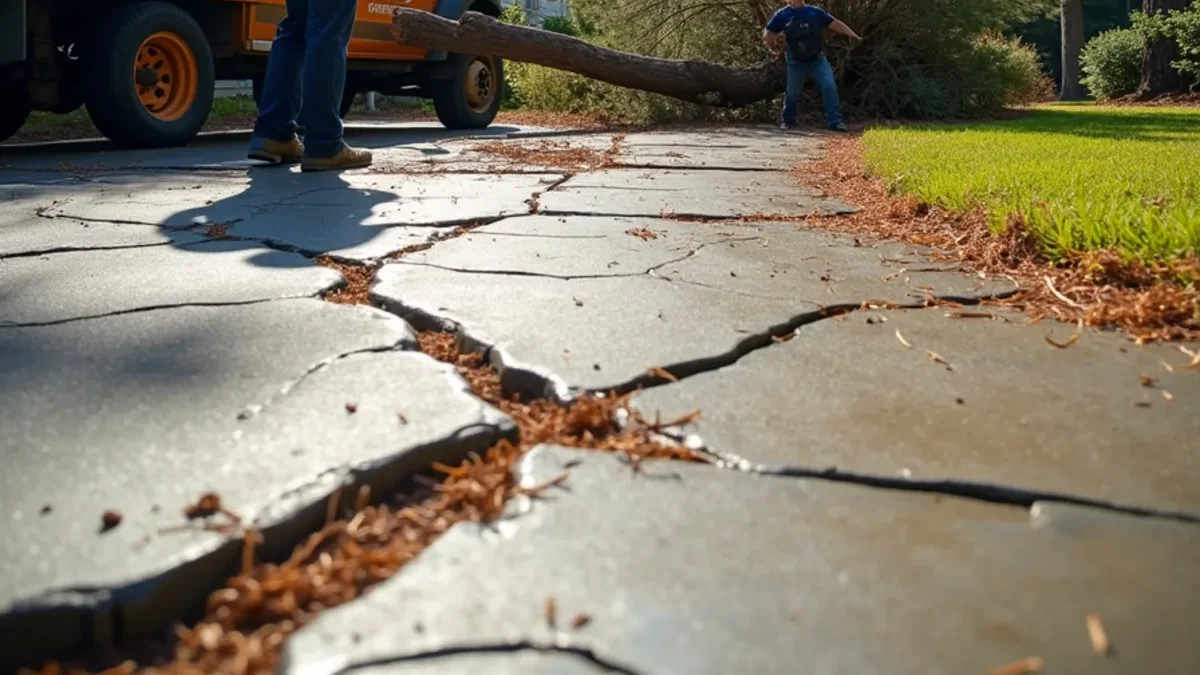
When a fallen tree damages your concrete driveway, immediately photograph the impact points and root upheaval before tree removal crews arrive. Contact your insurer under Coverage B (Other Structures), and hire a licensed concrete contractor to saw-cut shattered panels, backfill root craters with compacted stone, and repour with reinforced 4,000 PSI ready-mix.
Immediate Emergency Steps: Safety and Insurance Documentation
When a severe thunderstorm, microburst, or tropical cyclone brings a mature pine or oak crashing down onto your concrete driveway, your immediate response determines whether your insurance claim is approved and whether your repair lasts twenty years or fails within twelve months. In Aiken County and across South Carolina, fallen trees are the leading cause of sudden driveway structural failure, combining massive point-load impact with violent root-ball upheaval.
Before moving vehicles or allowing heavy tree service equipment onto your property, take the following immediate steps:
- Verify Electrical Safety: Always look up before inspecting the driveway. If the fallen tree pulled down overhead service drops or power lines, maintain a 30-foot perimeter and immediately contact Dominion Energy or Aiken Electric Cooperative. Never step onto wet concrete touching fallen lines.
- Comprehensive Photographic Documentation: Capture wide-angle establishing shots of the entire tree resting on the driveway, followed by high-resolution close-ups of every crack, shattered control joint, crushed panel edge, and uplifted slab section. Take photos showing how the trunk connects to the root ball.
- Notify Your Homeowners Insurance Carrier: In South Carolina, detached driveways are covered under Coverage B (Other Structures) of standard HO-3 policies. Provide your adjuster with initial photos and file a formal claim before the tree is cut into firewood.
- Mark and Inventory Impact Zones: Spray-mark fractured panel boundaries. Distinguish between cosmetic surface scuffs from falling branches and deep, full-depth structural fractures that split the slab into disjointed pieces.
Investing in prompt, professional evaluation—such as our specialized Storm Damage Concrete Repair and precision Concrete Driveway Repair services—ensures that subtle subgrade destabilization is caught early before water infiltration washes away the foundation.
Tree Removal Risks: Preventing Secondary Equipment Damage
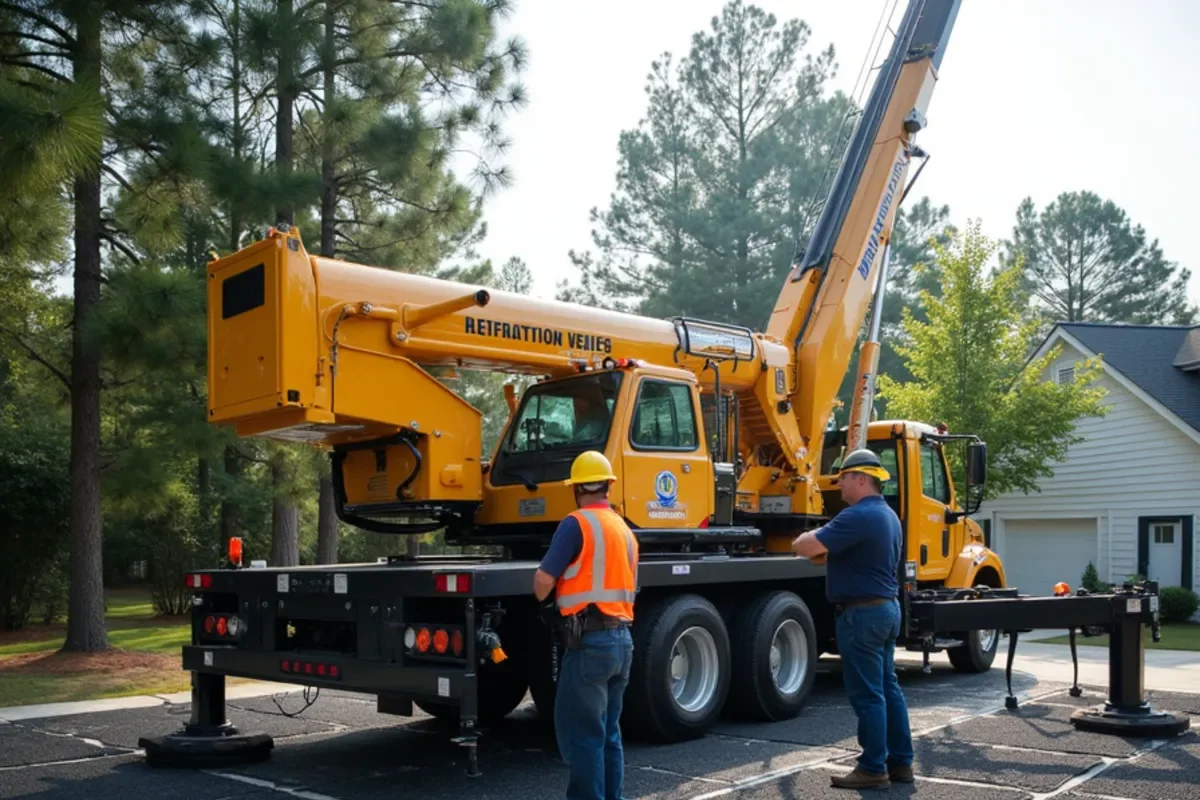
A major mistake South Carolina homeowners make after storm damage is allowing tree removal contractors to drive 50,000-pound knuckle-boom crane trucks directly onto undamaged sections of residential concrete. Standard residential driveways are poured 4 inches thick for passenger vehicles weighing 4,000 to 6,000 pounds. Concentrated outrigger loads from tree equipment will pulverize unreinforced concrete faster than the tree itself.
Require your tree removal crew to follow these strict protection protocols:
- AlturnaMATS Ground Protection: Insist that the tree service lays heavy 3/4-inch polyethylene ground protection mats over all driveway approach panels before positioning trucks or skid steers.
- Outrigger Pad Blocking: Crane outriggers must never sit directly on concrete. Require hardwood timber cribbing pads measuring at least 24x24 inches to distribute concentrated hydraulic loads across multiple square feet.
- Rigging Away From Sound Concrete: When large trunk sections are bucked and dropped, ensure the crew uses rigging lines and lowering friction brakes rather than free-falling massive logs directly onto the slab.
Evaluating the Damage: Impact Fractures vs Root Uplift
Tree damage to concrete flatwork falls into two distinct engineering categories, each requiring different restoration techniques:
High-Velocity Impact Fractures When a heavy trunk or massive branch strikes the center of a concrete panel, it creates a characteristic spiderweb fracture pattern with downward displacement. The impact pulverizes the brittle concrete surface and shatters the internal aggregate matrix. If the driveway lacks steel rebar reinforcement, the broken pieces settle into the subgrade at jagged angles, destroying the drive's uniform grade.
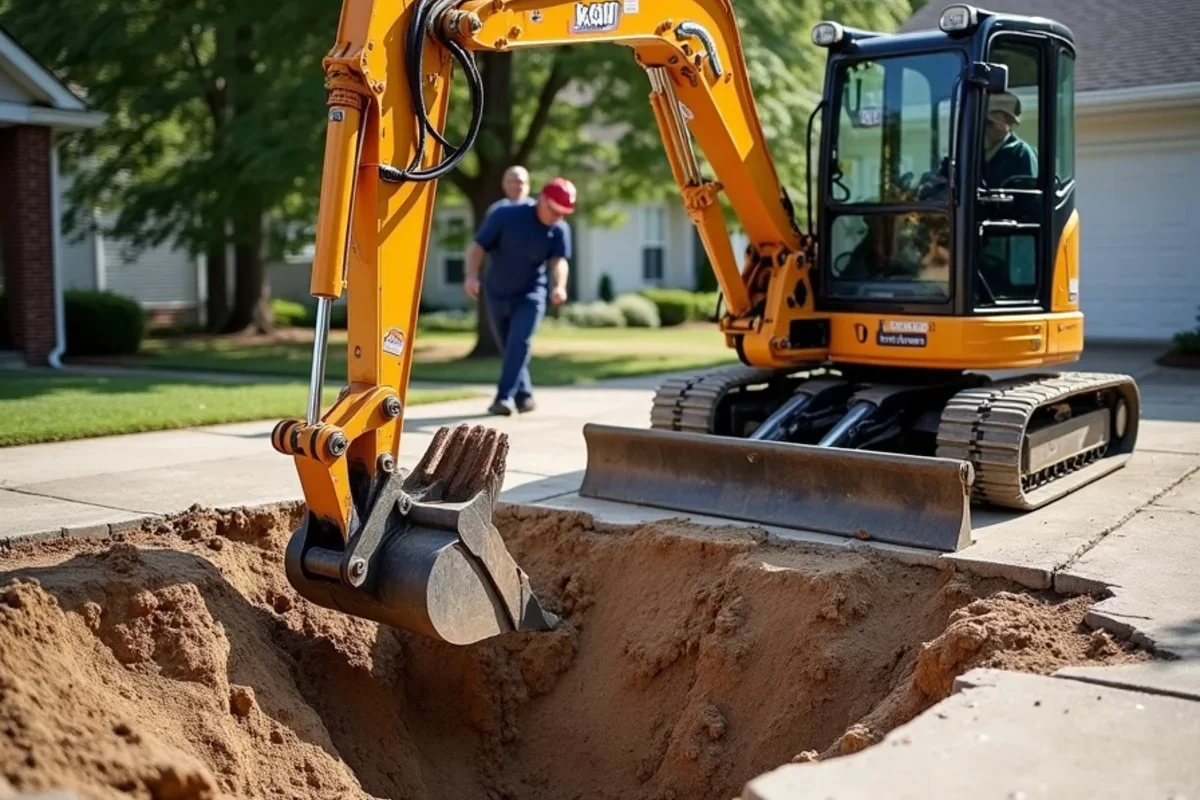
Root Ball Upheaval & Subgrade Cavitation When a tall tree uproots during hurricane-force gusts, the root plate pivots upward, lifting entire concrete driveway panels several inches into the air. When the root plate is eventually severed during tree cleanup, a cavernous subterranean void remains underneath the slab where the root structure previously anchored. Pouring concrete directly over this empty pocket without structural backfill guarantees catastrophic collapse under the first heavy pickup truck.
Repair vs Replacement Decision Table
The following engineering decision matrix illustrates how FPC Construction assesses storm-damaged driveways across Aiken and North Augusta:
| Damage Category | Visual Indicators | Engineering Impact | Recommended Restoration Scope |
|---|---|---|---|
| Localized Surface Gouging | Scratches, chips under 1/2-inch depth | Zero subgrade disruption, intact reinforcement | Precision diamond grinding, surface patching, penetrating silane sealer |
| Single Panel Impact Fracture | Full-depth cracks isolated within one panel | Slab continuity severed within joint lines | Full-depth saw-cutting, panel demo, subgrade re-compaction, rebar doweling |
| Root Upheaval (Multiple Panels) | Panels lifted 1 to 4 inches, tilted slope | Subgrade voiding, broken control joints | Tree root extraction, structural stone backfill, multi-panel replacement |
| Comprehensive Structural Failure | Webbed cracks across >40% of driveway | Subgrade liquefaction, drainage reversal | Complete driveway tear-out, 4-inch aggregate base rebuild, new 4,000 PSI pour |
Step-by-Step Engineered Driveway Restoration
Restoring a storm-damaged driveway to long-term structural integrity requires an uncompromising 6-step construction process:
- Step 1: Structural Diagnostic Inspection & Scope: Our technicians survey the entire driveway with optical laser levels, verifying slope, assessing adjacent panel stability, and measuring the exact square footage of damaged sections.
- Step 2: Clean Diamond Saw-Cutting: We cut full-depth, surgical joint lines along existing control joints using water-cooled Husqvarna diamond saws. This prevents jagged fracture transfer into surrounding sound concrete panels.
- Step 3: Hydraulic Demolition & Debris Extraction: Using compact Bobcat equipment equipped with hydraulic breakers, we break up the fractured concrete and haul the debris to an authorized recycling facility.
- Step 4: Root Crater Excavation & Geotechnical Backfill: We excavate all remaining tree root remnants that could decay and form underground voids. We backfill the excavation in 4-inch lifts with South Carolina DOT approved CR-14 crusher-run aggregate, compacting each lift to 95% Standard Proctor density with reversible plate compactors.
- Step 5: Grade 60 Steel Rebar Doweling & Chair Matrices: Into the sound adjacent concrete edges, we drill horizontal holes and epoxy-anchor 1/2-inch (#4) Grade 60 steel rebar dowels every 18 inches. We tie a continuous rebar grid elevated on plastic chairs so steel remains permanently suspended in the middle third of the pour.
- Step 6: 4,000 PSI Ready-Mix Pour & Broom Finishing: We place high-strength, low water-cement ready-mix concrete, consolidate with mechanical immersion vibrators, hand-tool control joints, and apply a non-slip broom texture matching the original driveway.
Expert Insights: Subgrade Void Remediation and Rebar Doweling
The most common failure in storm repairs occurs when uncredentialed contractors simply pour new concrete over an uncompacted root crater. Tree roots naturally hold high moisture content; as buried root fragments rot over subsequent summers, the soil loses volume, creating hollow caverns beneath the new slab.
At FPC Construction, our rule is simple: never pour over organic matter. We excavate until we reach undisturbed native subsoil, whether that is Aiken Sandhills quartz sand or Edgefield Piedmont clay. We install non-woven geotextile stabilization fabric across the subgrade transition zone to prevent fine sand particles from migrating downward into voids, creating an unyielding stone foundation.
Furthermore, isolated panel replacements must be physically tied into the surviving driveway. Without epoxy-anchored rebar dowels, the newly poured panel will settle independently during wet winter months, creating dangerous 1-inch tripping ledges and vehicle tire thuds.
South Carolina Building Codes and SCDOT Encroachment
When replacing driveway sections that transition into public roadways—such as state routes in Aiken County like SC-19, SC-421, or US-25—homeowners must adhere to South Carolina Department of Transportation (SCDOT) encroachment requirements. Driveway aprons within the state right-of-way must meet strict thickness specifications (minimum 6 inches with 4,000 PSI concrete) and preserve roadside swale drainage flow. FPC Construction coordinates necessary SCDOT permits and municipal building compliance, protecting homeowners from municipal stop-work orders and drainage fines.
Next Steps: Professional On-Site Storm Assessment
If severe weather or fallen trees have damaged your concrete driveway in North Augusta, Aiken, or surrounding South Carolina communities, do not wait for rainwater to undermine your subgrade. Call FPC Construction today at (833) 334-0468 for a free on-site engineering assessment and detailed written insurance estimate within 24 hours.
Speak Directly with a South Carolina Concrete Specialist
Guaranteed 1-hour callback · On-site evaluation in 48 hours · Free written estimate
Article Frequently Asked Questions
Key takeaways and common homeowner inquiries answered by our concrete team.