
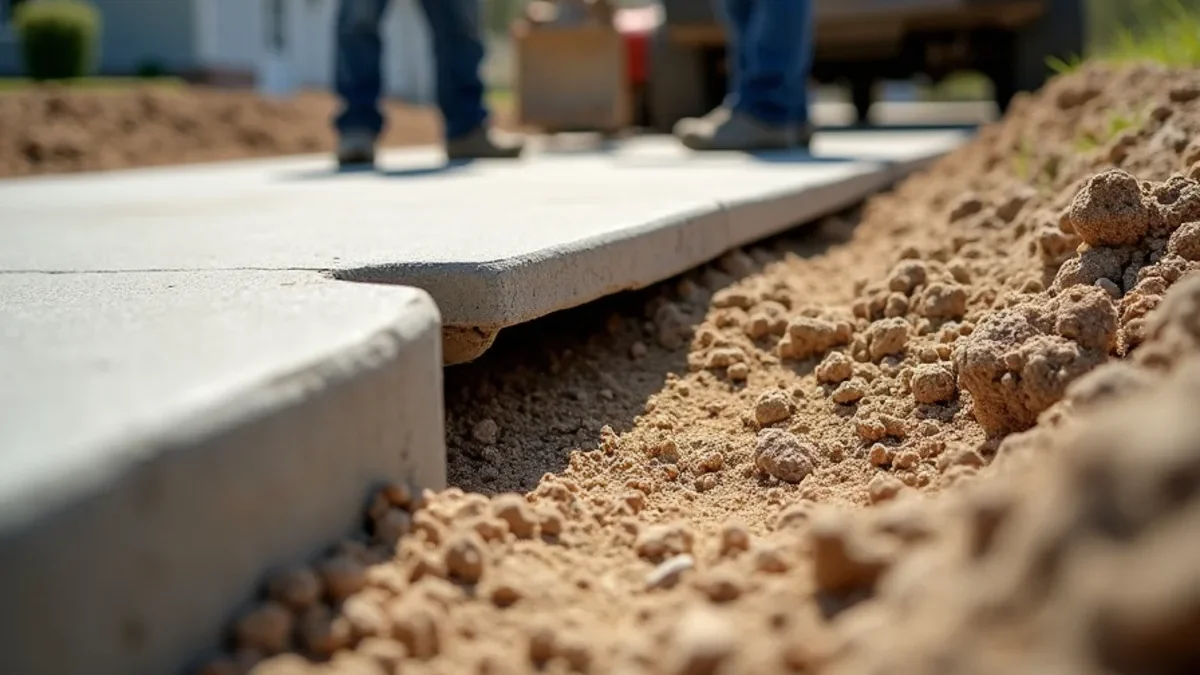
Water washing out soil beneath a concrete slab creates hollow cavities that cause cantilever structural cracking. Immediately redirect surface downspouts away from the slab edge, evaluate void depth with non-destructive sounding, backfill cavities with compacted stone or flowable grout, and install laser-graded perimeter concrete swales to permanently divert storm runoff.
Emergency Response: Halting Active Subgrade Soil Erosion
Seeing soil actively washing out from beneath the edge of your concrete driveway, patio, or garage slab is a structural emergency. Concrete flatwork possesses immense compressive strength when supported uniformly by solid earth, but it has almost zero tensile flexibility when spanning open air. The moment stormwater creates a hollow pocket under your slab edge, that section becomes an unreinforced cantilever beam. Parking a passenger vehicle or riding mower over that unsupported edge will snap the concrete like a chocolate bar.
If you observe muddy water channeling out from under your concrete or see daylight beneath your slab edges, take these emergency containment steps immediately:
- Stop Concentrated Water Discharge: Locate the nearest roof downspout or sump pump discharge. If downspouts are emptying water near the slab edge, attach flexible corrugated extension pipes to channel water at least 10 feet away from the concrete.
- Cease Heavy Vehicle Traffic Over the Void: Do not drive or park vehicles within 3 feet of the undermined slab edge. Place bright marker cones to ensure family members and service vehicles stay clear of the hollow concrete.
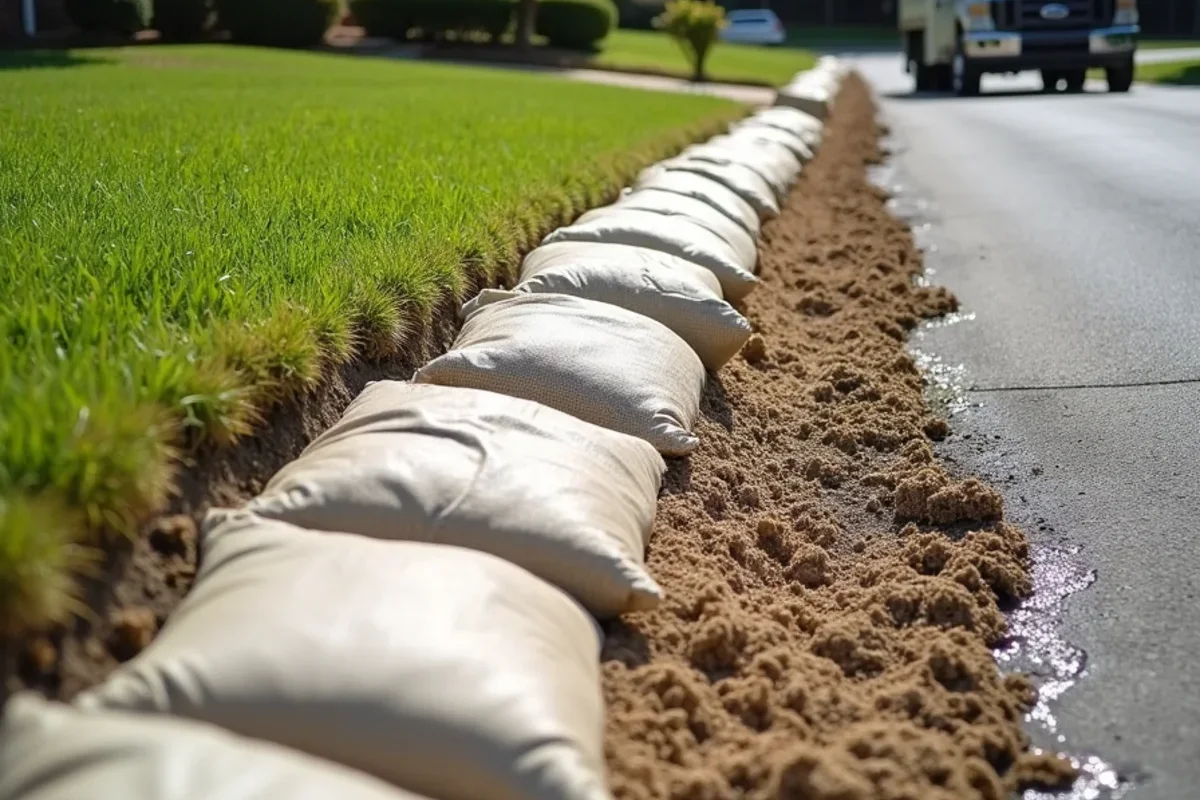
- Emergency Sandbag / Geotextile Armor: During active storms, place sandbags or heavy tarps weighted with gravel along the scoured edge to prevent torrential sheet flow from cutting deeper into the cavity.
Investing in comprehensive structural remediation—such as our specialized Concrete Washout & Void Repair and engineered Concrete Drainage Solutions—stabilizes your ground before hollow voids turn into catastrophic panel collapse.
Mechanics of Void Formation: Fall Line Hydrology & Sandhills Geology
Across North Augusta and Aiken County, property owners live directly atop the Atlantic Seaboard Fall Line—the geological boundary where the rocky Piedmont transitions into the deep Coastal Plain Sandhills. This environment creates extreme soil vulnerability beneath exterior concrete:
Highly Erodible Quartz Sand Sandhills soils consist primarily of round, poorly graded quartz sand with virtually zero cohesion. Unlike heavy clay soils that resist moderate water velocity, loose sand particles liquefy and mobilize rapidly when subjected to water flow speeds exceeding just 2 feet per second. A single afternoon thunderstorm delivering 2 inches of rain can scour away several cubic yards of subgrade sand in less than 30 minutes.
The Downspout Waterfall Effect A standard 2,000-square-foot roof generates approximately 1,250 gallons of water for every inch of rainfall. If that volume is concentrated through two downspouts discharging near the driveway margin, the resulting hydraulic torrent acts like a pressure washer against the subgrade. Water follows the path of least resistance—infiltrating along the edge of the concrete where soil compaction is weakest.
Buried Kaolin Clay Lenses In Horse Creek Valley communities like Graniteville and Clearwater, layers of slippery kaolin clay sit beneath sandy topsoil. When heavy rain saturates the sand, groundwater glides horizontally along the impervious kaolin layer, washing away the upper soil matrix and leaving massive subterranean caverns beneath driveways and patios.

How to Measure and Map Underground Slab Voids
Before executing structural repairs, technicians must determine the exact perimeter and depth of the hollow cavity beneath the slab. We employ three non-destructive diagnostic methods:
- Acoustic Hammer Sounding (ASTM D4580): Tapping the concrete surface with a heavy surveyor's hammer produces distinct sonic signatures. Solid, supported concrete emits a high-pitched, clear 'ping' or ringing sound. Concrete spanning an open air void produces a low-frequency, hollow 'thud' or drumming resonance.
- Calibrated Steel Probe Testing: Inserting long, calibrated steel soil probes beneath the slab edge reveals the depth, horizontal penetration, and vertical height of the cavity under the concrete.
- Optical Laser Level Profiling: We establish baseline elevations across the entire slab to detect whether the concrete has already deflected downward into the void.
| Void Severity Class | Cavity Penetration Depth | Concrete Condition | Required Engineering Response |
|---|---|---|---|
| Class 1: Minor Edge Scour | Under 6 inches inward | Slab level, zero cracks | Edge stone backfill, non-woven geotextile armor, downspout extension |
| Class 2: Moderate Cavitation | 6 to 24 inches inward | Slab level, hollow resonance | High-density foam injection or structural flowable fill, compacted stone shoulder |
| Class 3: Deep Cantilever Void | Over 24 inches inward | Hairline deflection, uncracked | Core-drilled slurry grout pumping, structural rip-rap armor, drainage swale |
| Class 4: Structural Collapse | Full subgrade loss | Fractured, displaced slab | Full demolition, subgrade excavation, 4-inch compacted stone, 4,000 PSI pour |
Void Remediation: Compaction, Slurry Grout & Flowable Fill
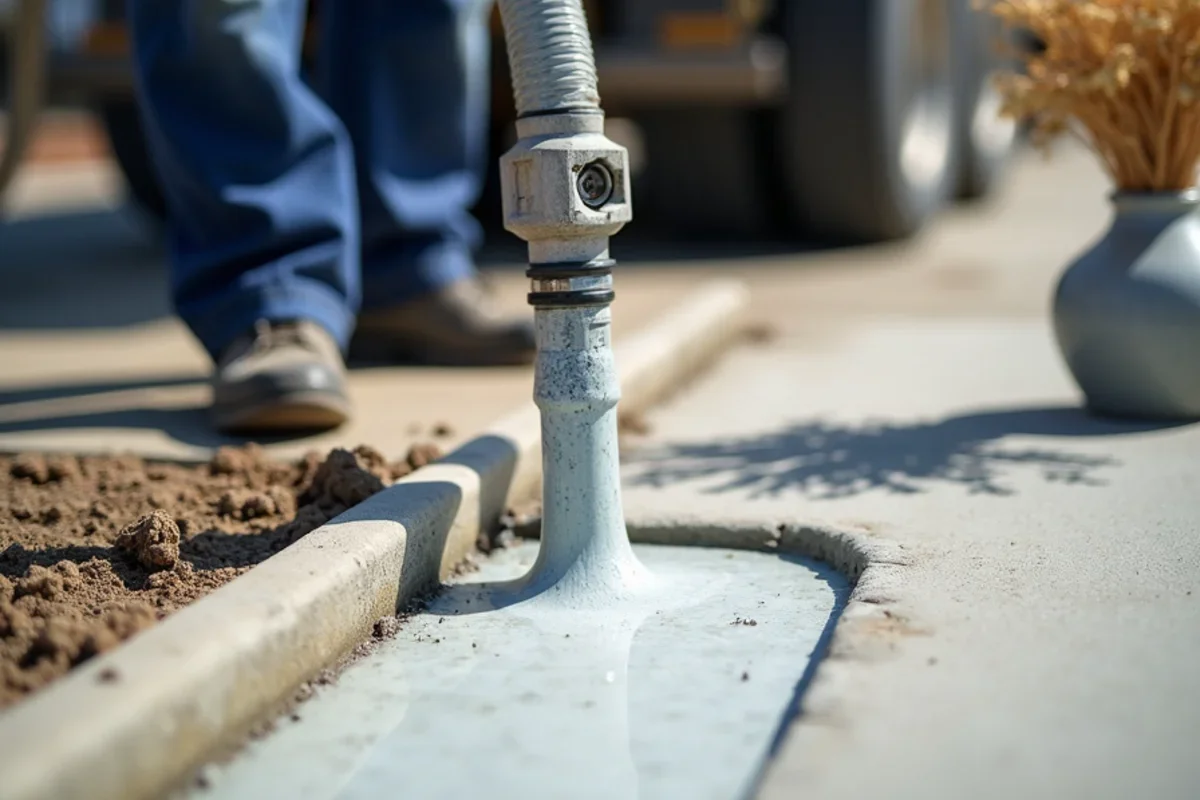
Filling an underground void requires material that can penetrate tight subterranean cavities, flow around rebar, and achieve high compressive strength without requiring physical mechanical compaction. Depending on project specifications, FPC Construction utilizes two proven void-fill systems:
System A: Structural Cementitious Flowable Fill For large voids, we mix a controlled low-strength cementitious material (CLSM) combining Portland cement, fine aggregate, and water. This self-leveling slurry flows effortlessly into every micro-cavity beneath the concrete, achieving 300 to 1,000 PSI compressive strength—far stronger than compacted native dirt, yet easily excavated if future utility lines are required.
System B: Closed-Cell High-Density Polyurethane For rapid residential lifting and void sealing, we drill 5/8-inch ports through the slab and inject expanding two-part polyurethane foam. The foam expands up to 15 times its liquid volume, displacing subterranean water, filling every microscopic void, and sealing out future moisture infiltration within 15 minutes.
Permanent Drainage Solutions: Concrete Swales and Catch Basins
Filling the void beneath your slab addresses the symptom, but repairing the surrounding drainage dynamics solves the root cause. If water continues flowing toward the concrete edge, erosion will simply bypass the patch and scour a new void elsewhere.
To guarantee permanent stability, FPC Construction engineers comprehensive water deflection systems:
- Monolithic Concrete Parabolic Swales: We form smooth, wide concrete drainage swales alongside driveways that capture sheet runoff and channel it safely into municipal catch basins at speeds that prevent erosion.
- Vehicular Trench Drains: In driveway transition areas where water runs downhill toward garage doors, we install heavy-duty ductile iron trench drains cast directly into the concrete slab.
- Rip-Rap Stone Edge Armoring: Along steep driveway shoulders, we install non-woven geotextile fabric lined with 6-to-12-inch crushed granite rip-rap stone to absorb hydraulic impact and eliminate soil loss.
The Real Cost of Delay: Void Fill vs Full Driveway Tear-Out
Addressing an edge washout during its early stages typically costs between $600 and $1,500 for localized void filling, aggregate stabilization, and downspout redirection. However, if delayed through one rainy South Carolina season, the unsupported slab will crack under vehicle weight. Once the concrete fractures, water enters the crack lines, rapidly destroying the entire driveway foundation. A full demolition, excavation, and replacement pour easily costs $6,000 to $12,000. Acting immediately upon noticing subgrade erosion saves thousands of dollars.
Next Steps: Protect Your Undermined Concrete Today
If you suspect hollow voids or active soil washouts beneath your concrete in North Augusta, Aiken, or surrounding communities, contact FPC Construction at (833) 334-0468 for a free on-site engineering assessment and detailed written scope within 24 hours.
Speak Directly with a South Carolina Concrete Specialist
Guaranteed 1-hour callback · On-site evaluation in 48 hours · Free written estimate
Article Frequently Asked Questions
Key takeaways and common homeowner inquiries answered by our concrete team.